
Exporting dry bird nest cups to China and understanding the fees
By The Little Nests·Published 10 October 2026
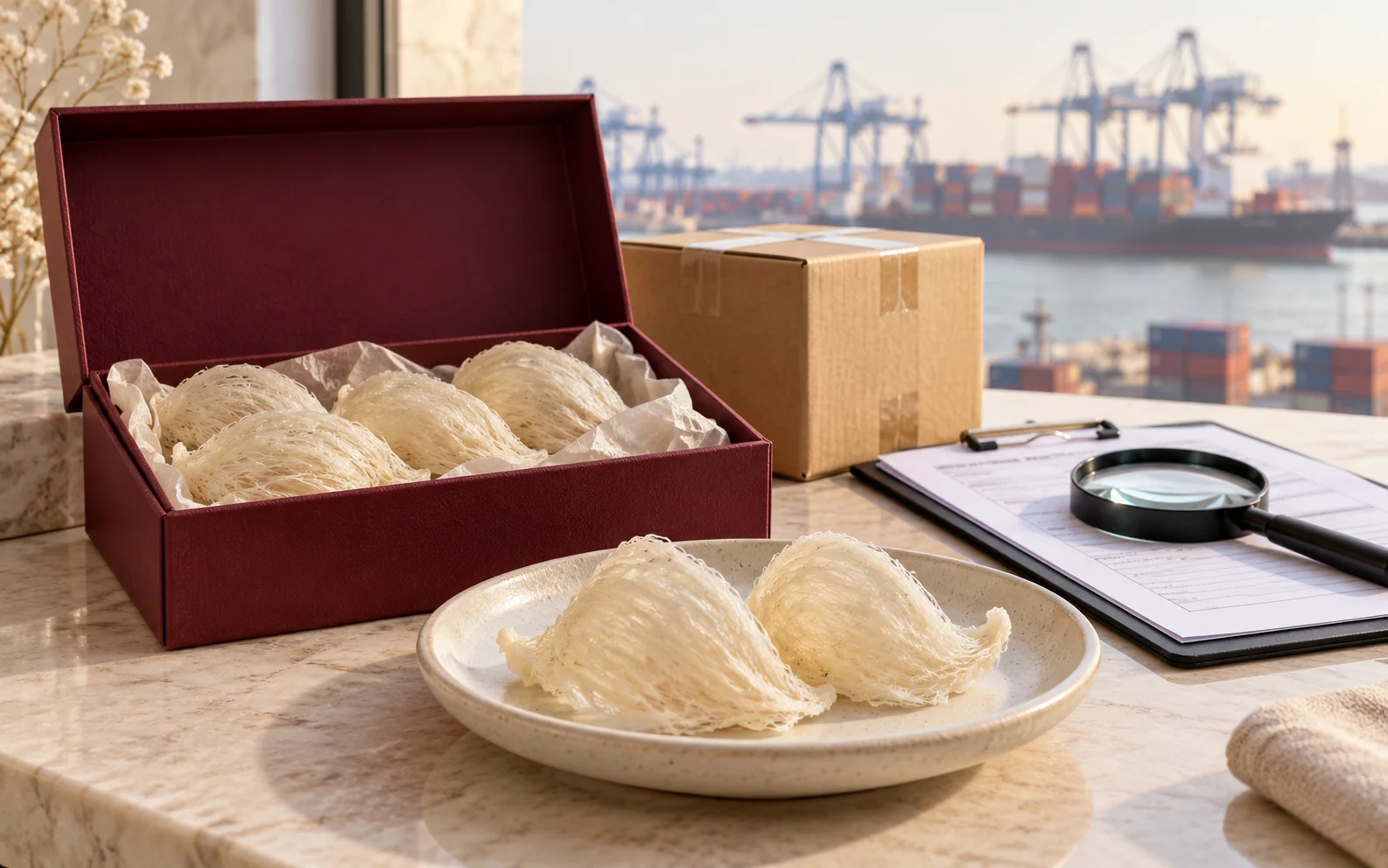
Understand China's dry bird nest import rules, export charges passed through without markup, and why these charges are added after all product discounts.
Reviewed on 10 October 2026. This guide covers Malaysian-origin dry edible bird nest cups imported into mainland China through an approved commercial route. It does not cover Hong Kong, Macao, prepared drinks or a different country's export requirements.
A China delivery quotation can include much more than transport: export documents, food-safety preparation, brokerage, import duty, import VAT and delivery after clearance. These costs have different charging bases. A useful quotation identifies which amounts are government charges, which are commercial services, and which still require confirmation.
We assist with the export arrangement. We do not earn profit from the export charges, add a markup or retain an assistance or service fee. All money collected as export charges goes to transport providers, taxes, customs clearance and inspection, including official certificates and third-party laboratory testing where applicable. Payments to authorities and payments to third-party providers are identified separately in the breakdown.
Product discounts are applied before export charges
We calculate all applicable product discounts first, including quantity discounts, limited-time and automatic promotions, vouchers, and manual bank-transfer discounts. Confirmed export charges are added afterward to the discounted product subtotal. These export charges are not discounted.
- First calculate the product subtotal after all applicable product discounts.
- Then confirm the third-party and official charges for the selected export arrangement.
- Add the full confirmed export-charge amount to the discounted product subtotal.
The calculation for these two parts is: discounted product subtotal + confirmed export charges. A larger product discount does not reduce the amount payable to the transport provider, tax authority, customs-clearance provider or inspection provider. This is our charging policy; customs valuation follows the separate rules explained below.
Why dry bird nest cups need a suitable import route
China's prohibited carried and mailed items list includes bird nests, with an exception for canned nests treated to commercial sterility. Dry cups do not meet that exception simply because they are cleaned, vacuum packed or sold in a sealed gift box. The list also provides a separate exemption where the competent Chinese authority has approved entry and the exporting country's official quarantine certificate is available. Ordinary personal luggage or personal mail should therefore not be treated as a delivery route for dry cups. Agriculture and Customs Announcement 470, Customs traveller declaration guidance.
Commercial entry follows a different process. Customs Announcement 2026 No. 37 permits qualifying Malaysian raw-clean and raw-unclean nests; it does not give every retail seller or every batch automatic approval. A dry cup ready for consumer preparation must be assessed as the relevant food product, while raw-unclean nests are processing material. GACC Announcement 2026 No. 37 on the official Zhejiang Single Window.
What the exporting company has to arrange
For the applicable Malaysian route, processing establishments need GACC registration. Products must be made after registration, undergo the required effective heat treatment, and remain traceable to their swiftlet premises. Each shipment of raw-clean nests must carry the original veterinary health certificate and the Malaysian Ministry of Health certificate. The current bilateral protocol specifies a core temperature of at least 70°C for at least 3.6 seconds. Malaysia China export protocol signed 13 November 2025.
DVS's China procedure connects premises and processing-plant registration with exporter registration and export-document applications through ePermit. The Ministry of Health separately requires raw-clean processing premises to be listed and registered with GACC through DVS. Registration status should be checked for the actual establishment supplying the batch. DVS export procedure for China, MOH raw-clean nest export listing.
These requirements explain some preparation costs, but they do not establish a universal retail export surcharge. Any separately quoted document, laboratory or inspection work must identify the authority or third-party provider receiving payment. Our export breakdown does not include a retained company assistance fee, profit or markup. A third-party provider's commercial charge should not be described as a government tax simply because its work supports compliance.
The fee breakdown to request
- Product price: the goods themselves, including any packaging already included in the selling price, with all applicable product discounts calculated before export charges are added.
- Export permits and official certificates: the applicable authority's charge and the charging unit, such as per permit or certificate. Request the underlying receipt where these are passed through.
- Testing and batch preparation: the agreed laboratory panel, sampling, treatment, traceability and export-label work. Establish whether these are charged per sample, batch, kilogram or order and whether they are already included in the product price.
- Third-party document preparation: an external export agent's or document provider's work preparing applications, declarations, invoices and packing lists, where required. This is a third-party commercial charge unless the line specifically identifies an official charge; we pass it through without markup and retain no assistance fee.
- International freight and insurance: the carrier, route, chargeable weight, included surcharges and insured value.
- China import duty and VAT: the declared classification, customs value, origin preference and tax rates used for the estimate.
- China clearance and delivery: broker service, terminal handling, tax-advance fees where used, and transport after release. Separate routine included costs from conditional storage, re-testing or return costs.
Some Malaysian charges are publicly described, but their scope matters. MAQIS publishes separate schedules for permits, inspection and quarantine; its 2013 First Schedule includes RM5 per export licence in the residual animal-products category. This is a schedule reference, not a confirmed assignment of every bird nest consignment to that category. The export office must confirm the applicable item and current payment. MAQIS fees and charges, MAQIS fee regulations and schedules.
Penang's Ministry of Health service page lists an export health certificate at RM100 for a premise with MOH HACCP certification and RM300 without it. Confirm applicability with the issuing office for the particular China certificate. Neither figure includes a laboratory's quotation, a veterinary certificate, freight or an agent's handling fee. MOH Penang service fees.
China duty and VAT are separate charges
The 2026 China tariff lists bird nests under 0410.9010, with a 25% most-favoured-nation duty and a 0% rate for qualifying ASEAN origin under ACFTA and RCEP. The correct declaration code and eligibility must be confirmed for the actual goods. A seller shipping from Malaysia or Singapore does not prove Malaysian origin, and prepared drinks or mixtures need a separate classification review. 2026 China tariff schedule, printed page 93, row 485.
The 0% preference depends on satisfying origin rules and making an accepted preferential claim. MITI identifies Form E for ACFTA and explains that an ordinary non-preferential origin certificate does not grant tariff concessions. Ask which preference and proof the importer will use; do not assume a DVS origin document automatically replaces that proof. MITI preferential certificate of origin guidance.
Import VAT remains separate even where duty is 0%. China's VAT Law provides a default 13% rate for goods and imports. The 2026 interpretation expressly excludes bird nests from the agricultural-products category eligible for 9%. Taken together, these provisions support 13% for ordinary general-trade dry bird nests, subject to the actual classification and any applicable special policy. China VAT Law, Articles 10 and 14, 2026 VAT scope annex, page 7.
Since 1 June 2026, China and Malaysia exchange origin data electronically for RCEP and ACFTA. As of this guide's review date, the transition allowing manual electronic submission when data are missing runs through 30 November 2026; the published arrangements change from 1 December. Document handling must follow the shipment date. GACC explanation of China Malaysia origin-data exchange.
How the landed amount is calculated
Customs value is generally based on the transaction price plus transport, related costs and insurance to the Chinese entry point before unloading, with legally required adjustments. Separately identified transport after unloading and import taxes are excluded under the stated conditions. Customs value is therefore not necessarily the shop's product price. China Tariff Law, Articles 24 to 26.
Use V for the customs value in CNY, d for the accepted duty rate and C for any applicable consumption tax. The calculation is:
- Import duty = V × d.
- Import VAT = (V + import duty + C) × applicable VAT rate.
- Cash landed amount = goods and included transport or preparation costs + import duty + import VAT + remaining clearance and delivery costs.
Do not add freight or preparation twice when it is already included in the goods price or quoted package. Customs valuation and the customer's invoice are related but have different purposes. Import VAT may qualify as an input credit for an eligible business importer with the required documents; that does not remove the initial customs payment or automatically reduce a retail buyer's bill. China VAT Law, Articles 14 and 16.
Why a 50g box can attract more than 50g of freight
Carriers can charge the greater of actual packed weight and volumetric weight. DHL Malaysia's 2026 guide calculates volumetric kilograms as length × width × height in centimetres divided by 5,000 for each piece. Other carriers or freight services can use a different divisor and rounding. DHL Malaysia 2026 service and rate guide.
A hypothetical 30 × 20 × 15cm gift parcel is 1.8 volumetric kg by that formula, even if the packed parcel weighs 0.8kg. Its nest net weight is a third, different measurement. Fuel and remote-area surcharges can also affect the quoted amount. DHL Malaysia surcharge descriptions.
Document and batch costs also have minimums. For example, allocating a hypothetical CNY300 batch expense across 30 participating boxes gives CNY10 per box; allocating it across three boxes gives CNY100. This is allocation arithmetic, not an official fee or a promise that separate customer orders can share one consignment.
Who pays the import charges
The agreed contract decides who bears the commercial cost. Under Incoterms 2020 DAP, the buyer handles and pays import clearance; under DDP, the seller takes that responsibility. Both need a named destination, and a seller must be able to arrange lawful import clearance before offering DDP. The terms allocate responsibilities; they do not waive food-import rules. ICC explanation of DAP and DDP.
Before accepting a quotation, establish whether duty, VAT, brokerage and delivery to the recipient are included; who is the importer of record; what happens if Customs changes the assessment; and who bears a documented storage or return cost. A single description such as shipping fee is insufficient to answer these questions.
Reading the Send to China by us option
Selecting Send to China by us chooses assistance with a China export arrangement. If any applicable fee row says Quote required, that amount must be confirmed in an itemised quotation before checkout with this option. Once confirmed, the export charges are added at checkout after all applicable product discounts, including limited-time promotions, and are not discounted. We pass these charges to the relevant transport, tax, customs-clearance and inspection recipients without retaining profit, markup or an assistance fee.
The arrangement remains subject to the actual product, approved exporter and importer, destination and documentation. Selecting the option does not establish a company's registration or guarantee customs release.
The information icon should be read alongside the selected display currency. Converted amounts are estimates; the written quotation must identify its settlement currency, exchange-rate basis, validity, included taxes and services, exclusions and any agreed allocation per order, box or shipment. A currency display change does not alter the approved import route or the customs tax basis.
For a reliable quote, provide the selected packaging, nest net weight, quantity and China destination, then review the confirmed itemised amount before checkout. The discounted product subtotal and the full export-charge amount should be shown separately. Keep the commercial invoice, third-party invoices, official charges and customs tax documents together so the final bill can be reconciled.